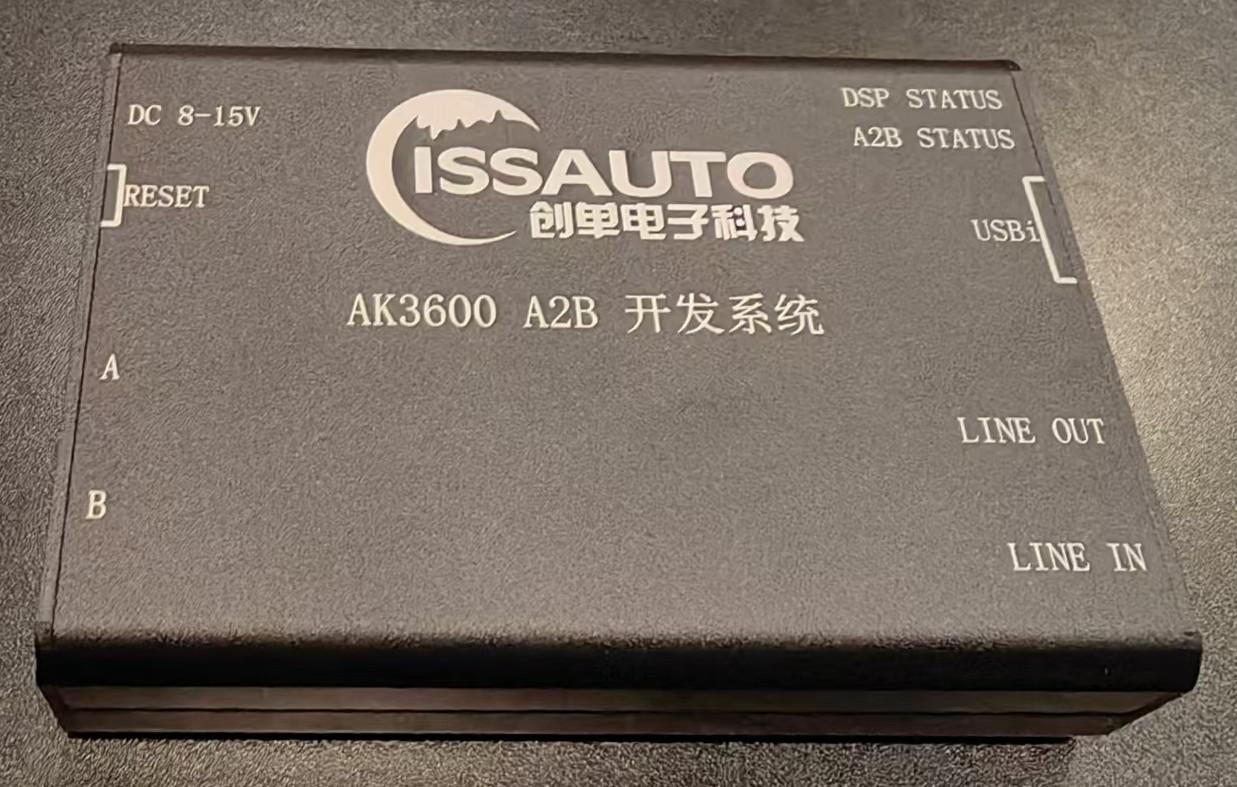
Note: A2B in this article refers to Automotive Audio Bus, an in-vehicle digital audio transmission protocol, and has nothing to do with the mathematical expression a²+b².
A2B 2.0 is the next-generation automotive digital audio bus officially released for mass production by ADI in April 2026. It delivers 98.304 Mbps full-duplex bandwidth, four times that of A2B 1.0, and supports up to 11 slave nodes on a single master node, 15 m node spacing, and an 80 m total bus length, while maintaining 62 μs deterministic latency. This article breaks down its key parameters, the selection differences among the three variants, the engineering significance of Ethernet tunneling (OASPI), and five judgment points for selecting an in-vehicle audio system. It is intended for automotive electronics engineers and audio system architects.
Overview
A2B (Automotive Audio Bus) is an automotive digital audio bus introduced by ADI in 2016. Its value proposition is refreshingly simple: with a single unshielded twisted pair, it links the cabin's dispersed microphones, speakers, and acceleration sensors into a daisy chain, carrying data, clock, and power together.
Before A2B, in-vehicle audio used analog connections. Every microphone had a shielded wire and every speaker a pair of wires, running from the head unit to the doors, roof, and seats. The harness was heavy, costly, and susceptible to interference, and features requiring multi-channel synchronous sampling, such as active noise cancellation, were all but impossible.
With A2B, this link became digital. Over ten years, more than 35 OEMs have adopted it, with cumulative installed nodes in the hundreds of millions, making A2B the de facto standard for in-vehicle audio connectivity.
On April 28, 2026, ADI officially announced mass production of A2B 2.0 (ADAA245x series).
Key Parameters of A2B 2.0
Bus bandwidth
A2B 1.0: approx. 24.6 Mbps
A2B 2.0: 98.304 Mbps full-duplex
Change: 4x
Audio channels
A2B 1.0: 32 upstream / 32 downstream
A2B 2.0: 119 upstream / 119 downstream
Change: approx. 3.7x
Slave nodes
A2B 1.0: up to 10
A2B 2.0: up to 11
Change: +1
Node spacing
A2B 1.0: 15 m
A2B 2.0: 15 m
Change: unchanged
Total bus length
A2B 1.0: 40 m
A2B 2.0: 80 m
Change: 2x
Latency
A2B 1.0: 62 μs (deterministic)
A2B 2.0: 62 μs (deterministic)
Change: unchanged
Ethernet tunneling
A2B 1.0: not supported
A2B 2.0: supported, up to 23 Mbps (Layer 2)
Change: newly added
1.0 cable compatibility
A2B 1.0: —
A2B 2.0: backward compatible
Change: smooth upgrade path
A note on the channel-count figure: 119+119 is calculated at 48 kHz sampling and 16-bit word length. Switching to 24-bit high resolution, or raising the sample rate to 96 kHz, multiplies the bandwidth occupied per channel, and the number of usable channels drops significantly. This is precisely why bandwidth had to reach 98.3 Mbps — not for today's 32 channels, but to reserve throughput headroom for 24-bit / 96 kHz and large-scale sensor arrays.
Why In-Vehicle Audio Cannot Simply Move to Ethernet
This is the question most often asked during architecture selection — and the one most often answered incorrectly.
Ethernet's strengths are throughput and ecosystem, but it has two structural weaknesses.
The first is non-deterministic latency. Ethernet is packet-switched, so latency is affected by protocol-stack scheduling and network congestion and fluctuates with load. Road-noise cancellation (RNC), however, requires the anti-noise wave to be released at the exact instant the noise reaches the ear — an extremely narrow and strictly constant time window.
Take RNC as an example: chassis acceleration sensors capture tire vibration → the signal returns over the bus to a central DSP (such as a SHARC) → the anti-noise wave is computed → it is sent back over the bus to the speaker. In this closed loop, latency jitter at any stage directly degrades cancellation performance.
What A2B provides is 62 μs of deterministic latency — it does not vary with bus load. Note that "deterministic" is here more engineering-significant than "low latency" itself.
The second is clock synchronization. Audio systems require all nodes to sample in phase. Ethernet's AVB/TSN can do this, but needs additional protocol stacks and hardware support; A2B embeds clock and synchronization signals into the data stream at the physical layer, so all nodes are inherently phase-aligned.
For this reason, A2B 2.0 introduces Ethernet tunneling (OASPI interface, up to 23 Mbps) not to replace Ethernet, but to let audio nodes "ride along" onto the SDV backbone: audio uses A2B's deterministic channel, while diagnostics, OTA, and non-real-time data travel over the tunnel.
How to Choose Among the Three Variants
The ADAA245x series currently has three variants with clear positioning:
ADAA2457
Positioning: full-featured
Key differentiators: OASPI Ethernet interface, 8 configurable SIOs, 2 I2S/TDM clock domains, 4 PWM channels, 4-channel ASRC input/output, configurable as master or slave
ADAA2456
Positioning: mid-range
Key differentiators: no Ethernet interface, configurable as master or slave, streamlined interfaces and peripherals vs. the 2457
ADAA2455
Positioning: low-cost slave node
Key differentiators: slave-only, 4 high-dynamic-range microphone inputs, suited to microphone modules and sensor sub-nodes
Selection logic:
• Master node (head unit / amplifier): choose the 2457 if you need Ethernet tunneling, otherwise the 2456
• Speaker module / DSP-equipped slave node: 2456
• Pure microphone module / sensor sub-node: 2455, the most cost-effective
Actual Impact on System Design Cost
A2B 2.0 improves interference immunity at the chip's physical layer, sharply reducing system dependence on external filtering and protection components:
• External component count reduced by more than 50%
• System cost reduced by about 30%
• Harness weight reduced by up to 75% (daisy-chain topology vs. conventional point-to-point analog wiring)
In space-constrained scenarios such as cabin domain controllers or active-noise-cancellation modules, halving the component count brings not only BOM savings but also easier board layout and shorter EMC remediation cycles.
For ODMs and Tier-2 suppliers, this is a substantive opportunity: A2B 2.0 is backward compatible with 1.0 cables and connectors, meaning existing platforms' audio modules can be "chip-swapped" without redesigning the harness. Such incremental retrofit projects are usually easier to win than brand-new platforms.
Five Judgment Points for In-Vehicle Audio System Selection
- Define functions before the bus. Do you need RNC, occupant monitoring, multi-zone sound fields, or just basic audio and hands-free? Functions determine channel count and latency requirements — not the other way around.
- Work out the channel budget. Calculate against the target word length and sample rate, not the nominal 48k/16-bit figures. 24-bit / 96 kHz consumes several times the channels.
- Confirm whether latency is "deterministic" or a "typical value." A vendor's typical latency is meaningless; you need the deterministic upper bound under worst-case conditions.
- Assess 1.0 installed-base compatibility. For an upgrade to an existing platform, whether cables and connectors can be reused determines whether the project is a "chip swap" or a full redo.
- Check toolchain maturity. A2B is uniformly supported by SigmaStudio+; before evaluation, confirm the software license path (A2B 2.0 software requires contacting an ADI sales representative).
Four Common Pitfalls in Engineering Deployment
- Design bus diagnostics in advance. A2B 2.0 supports per-link line diagnostics (no bias required) and automatic discovery, but fault reporting and degradation strategies must be designed at the system level, otherwise field link breaks can only be located by rework.
- Budget power for the farthest node. Phantom power attenuates progressively along the daisy chain; the end node's voltage and current margin must be calculated separately.
- Don't test EMC on a single board only. A2B's physical layer is optimized for automotive EMC/ESD, but vehicle-level conducted and radiated immunity still needs system-level verification, especially in segments routed parallel to high-voltage harnesses.
- Wake-up strategy. Wake-on-A2B activity is supported, but it must align with vehicle network management (NM) to avoid a mismatch where audio nodes wake while other ECUs remain asleep.
Acoustic Inspection and Vibration Measurement: Two Independent Product Lines
It should be clarified that acoustic inspection and vibration measurement, while both belonging to condition monitoring, follow different technical paths: acoustic inspection captures airborne sound-pressure waveforms and suits indirect sensing of abnormal noise, leaks, and friction defects; vibration measurement is attached to equipment housings and suits structural fatigue and bearing fault diagnosis. ISSAUTO's industrial acoustic inspection line and smart sensor line are two independent product lines and can be selected according to defect type.
Back to the matter at hand: on the Industrial Voiceprint Inspection Station ISS-ACS-100 deployed by Shanghai Chuangdan Electronics (ISSAUTO), the approach is to extract 88-dimensional acoustic features, make the judgment locally at the production-line edge, with a cycle time of ≤5 s per unit and a good-unit recognition rate >99.5%; no algorithm team is needed — 20–30 good units running a One-Class baseline are enough to build the model, deployment takes about 3 days, and no defective samples are required. For scenarios such as in-vehicle audio / A2B, the key is that data never leaves the workshop and judgment is completed locally, avoiding uploading sound samples to the cloud. Boundary: for production lines dominated by high-frequency continuous impact noise, or lines requiring a cycle time of <1 s per unit, this solution is not applicable.