Introduction: The Paradigm Shift in Acoustic Quality Inspection
In industries such as motor manufacturing, automotive components, consumer electronics, and pipeline monitoring, acoustic quality inspection has long been the "blind spot" of production lines. Vibration can be fully automated, yet acoustics remains stuck at the stage of "veteran inspectors holding a stethoscope." The reason is not that companies are unwilling to change, but that there was never a complete closed-loop solution spanning collection, annotation, training, and independent hardware inference.
Today, that blind spot has been filled.
This product is independently developed by Shanghai Chuangdan Electronics Technology Co., Ltd. (ISSAUTO). Its core members come from leading automotive companies, and its acoustic algorithms originate from Donghua AI Lab. It is a National High-tech Enterprise.
Product Positioning: Hardware Execution Endpoint + Platform Training Ground
The Industrial Voiceprint Inspection Station ISS-ACS-100 is not a "closed black-box device," but a production-line acoustic quality inspection terminal that is fixed-mounted, non-contact, and made intelligent by an open platform.
Its working logic proceeds in three steps:
① The hardware collects sound samples on site
↓
② Samples are uploaded to the ISSAUTO industrial-grade AI acoustic inspection platform (open beta applications pending)
→ graphical annotation → intelligent training → model evaluation → factory-mode verification
↓
③ The trained model is synchronized back to the inspection station
→ the hardware performs independent edge inference, with no server dependency and plug-and-play operation
Core philosophy: only when the device itself makes no noise can it hear the workpiece clearly.
Hardware Architecture: Why Fixed-Mount Is the Right Answer
Base
Components: 6061 aluminum alloy, ≥500 g, 4 silicone vibration-damping feet
Key parameter: isolates table/stand-borne sound, attenuation of 30 dB+
Adjustment arm
Components: three-dimensional graduated adjustment, M4 locking at each segment
Key parameter: displacement after locking ≤0.1 mm/24 h
Probe
Components: nickel-plated brass housing (EM shielding), M8 magnetic cardioid microphone
Key parameter: pickup angle ±15°, with 2 mm silicone damping between probe and arm
Interface
Components: three physical buttons (train / good / defective) + dual-color light guide ring
Key parameter: green = good unit, yellow = defective unit
The ISSAUTO Platform: Making Everyone an Acoustic Expert
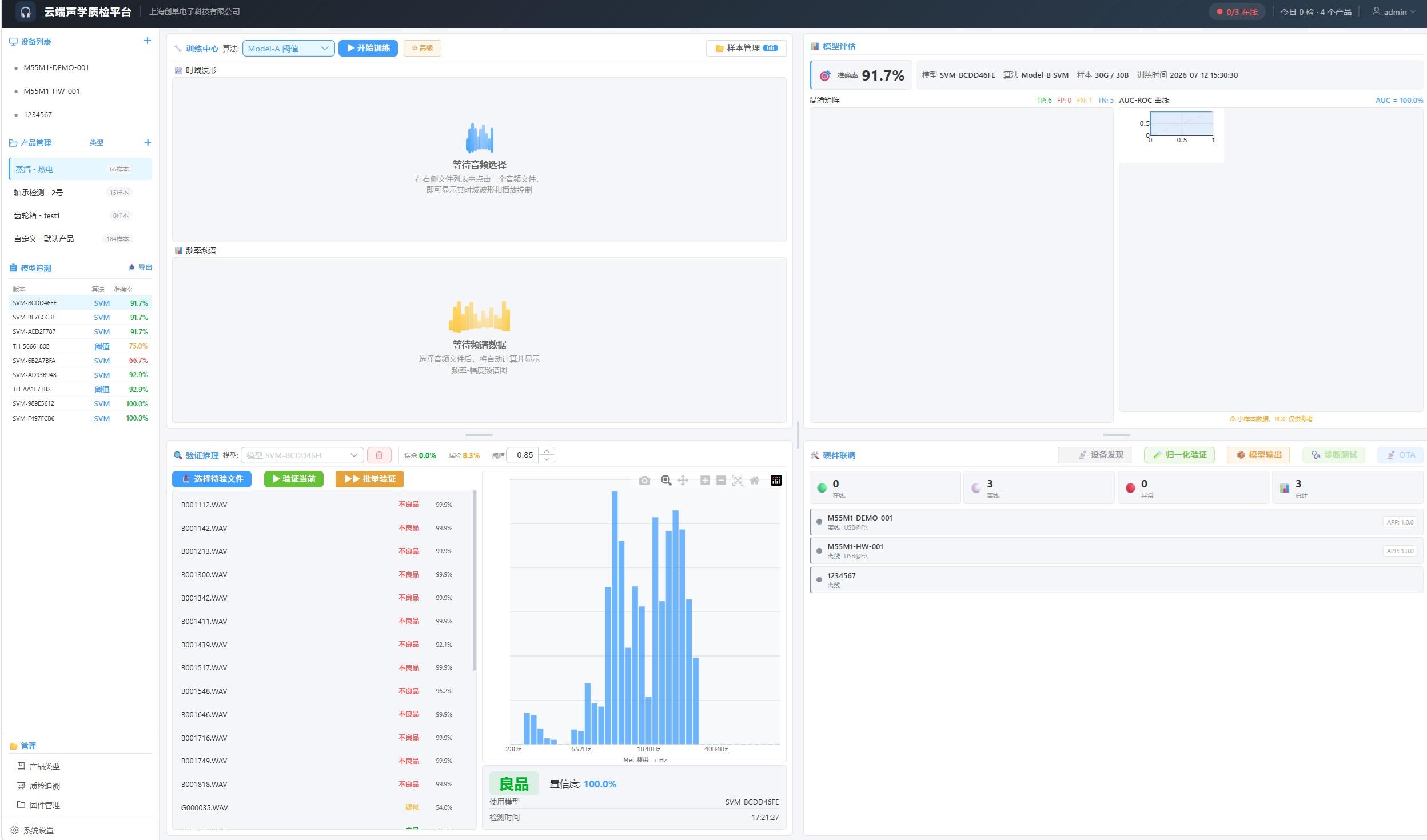
What makes the inspection station "smart" is a complete software platform behind it. The ISSAUTO industrial-grade AI acoustic inspection platform is a one-stop development platform for industrial acoustic AI, migrating the "annotation → training → deployment" paradigm proven in visual AI into acoustic inspection.
The platform is about to open its first batch of beta applications (limited slots). Core capabilities:
Full-process closed loop: collection → annotation → feature engineering → training → evaluation → verification → deployment, all in one platform
Graphical operation: quality engineers need no code; model training is done by drag-and-drop
Intelligent training acceleration: smart recommendation of training sets + incremental training, 70% overall speedup
Small-sample modeling: stable modeling with just 20–30 samples per single class (good or defective)
Good-unit baseline learning: unsupervised mode, baseline built from good-unit sound only, deployable with zero defective samples
Factory-mode verification: end-to-end verification with real production-line recordings, feature + confidence viewable per module
Automatic code generation: graphical flowcharts → complete engineering code generated automatically, no manual coding
Plug-and-play protocols: supports industrial protocols such as Modbus, direct connection to PLC and MES
Dual Models in Parallel: AI + Threshold, Zero Trust Crisis on Site
The inspection station has two built-in models, switched by a physical toggle:
• AI mode (blue ring): SVM/CNN model trained on the platform, outputs Pass/Fail + confidence percentage
• Threshold mode (red ring): frequency-band energy rule-based, requires no defective samples, the screen directly shows which band exceeds the limit and by how many dB
The veteran inspector's workflow becomes: AI screens first → suspect units → switch to threshold mode to inspect the band → confirm → conviction. AI does not replace people; it helps them narrow the scope of recheck.
Edge-Independent Inference: Train and Run, No Server Dependency
Once the model is trained on the platform and synchronized to the inspection station, the station runs completely independently:
• ARM Cortex-M55 MCU, CMSIS-DSP optimized across the full pipeline
• Built-in NPU, audio inference ≤10 ms, no GPU required
• Detects minimum 3 dB sound-pressure-level difference, 5 Hz frequency resolution
• Pure local computation — no network, no cloud, sound data never leaves the workshop
Validated Across Six Industries
Motor production line abnormal-noise detection: miss rate 8% → <0.1%, saving 3 listening inspectors per line
Automotive component assembly verification: missing-part detection rate 99.5%+, real-time MES integration
Consumer electronics sealing rapid check: 30 s per unit → 2 s, 10x efficiency gain
Pipeline vibration voiceprint monitoring: IP68 waterproof, 50–100 m detection range, replacing manual inspection
Power electronics (wind power / transformers): real-time abnormal-sound detection, 2 s per unit
Machine-tool component full inspection: detection rate 99.9%+, 10 s per unit, 100% automated full inspection
Platform Opening Soon · First-Batch Beta Applications Now Open
The ISSAUTO industrial-grade AI acoustic inspection platform is about to open, and we are now accepting first-batch beta applications from manufacturers worldwide (limited slots).
Looking at ISSAUTO's Technology Foundation Through "ISS-ACS-100 Platform Capabilities"
To discuss "ISS-ACS-100 platform capabilities," let us first set out verifiable numbers. ISS-ACS-100 extracts 88-dimensional acoustic features, fused from three segments: MFCC spectrum, envelope modulation, and time-domain statistics. 20–30 good units are enough to build a One-Class baseline model, with no defective samples required. The good-unit recognition rate is >99.5%, and the cycle time is ≤5 s per unit. Quality engineers use graphical annotation to build production-line acoustic inspection in about 3 days, with no algorithm team. The model designation is ISS-ACS-100, using an open-platform plus fixed-hardware architecture, with no custom projects. Boundary: for extremely small leaks with slow seepage (no acoustic emission), acoustic sensitivity is limited and other methods are needed.